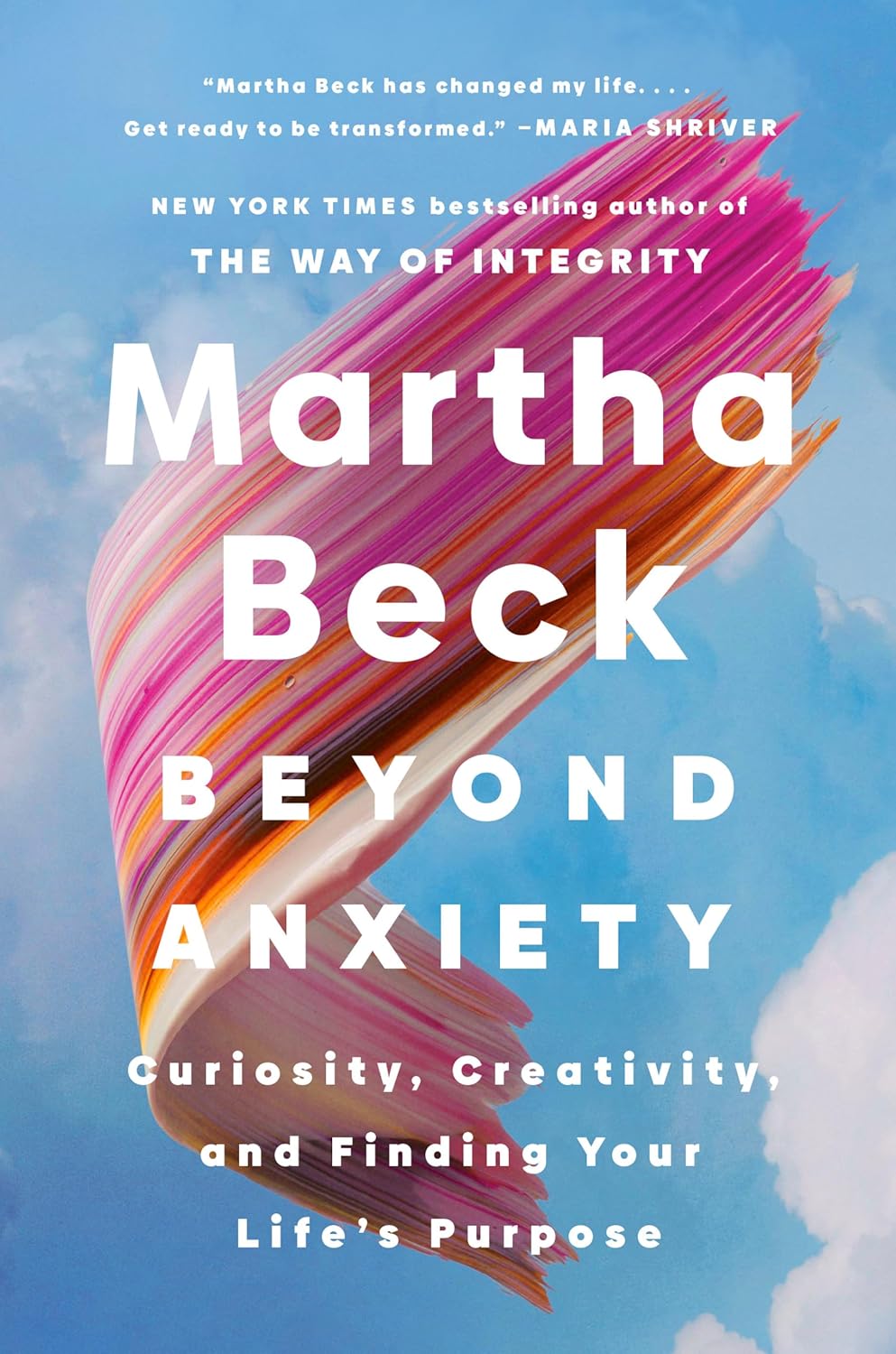
Former Harvard sociologist turned life-coach, Dr. Martha Beck explains how to (1) reduce your anxiety spirals and (2) live a life filled with peace, meaning, and joy. Hint: the answer isn’t to think your way out.
Our brains get stuck in repeating patterns that can lead to anxiety spirals, a feedback system that can increase anxiety indefinitely. Beck explains that anxiety is a left-hemisphere phenomenon, and our instinct is to try to use our left-brain logical thinking to reason our way out of anxiety. Instead, she recommends engaging in the right-hemisphere act of being creative, which engages different parts of our nervous system, and creates a balance within us. (Though she does admit the gross oversimplification of left and right hemispheres.)
But let’s start with the most useful parts of the book first. Beck provides some specific techniques for when you are spiraling. Specifically, her strategy is to detach yourself from your anxiety mentally, utilizing a branch of therapy called Internal Family Systems (ISF). Your anxious brain doesn’t respond to conscious decisions, and if you treat that part of you like a scared animal, or your “creature self”, you can calm it down using kind internal self talk, breathing deeply, unfocusing your eyes, and reassuring until your creature goes “limp”. Step outside of the emotions, but allow yourself to watch them happen, while the “true you” remains centered and compassionate.
Once you are out of the anxiety spiral, take some action, by going for a walk, cooking, gardening, playing drums, drawing, or journaling. The anxiety cure touted here isn’t so much of an anxiety deescalation as it is a prevention technique. Once you find the creative thread that interests you, stay with it. Find at least ten minutes a day to be curious and play.
Beck says that growing up in a WEIRD society (western, educated, industrialized, rich, and democratic) is the reason we’re all anxious and the reason why we’re all so hesitant to live creative lifestyles. Curiosity and play is for children, not for rational adults who need to check tasks off their list. In fact, we all apply ourselves to our jobs and families so much that she thinks most of us are too tired to even be creative. We’ve lost our creative spirits, and so she recommends sleep and self-care until you’re bored of them.
Beck’s creativity recommendations are all generally out of touch. She herself takes a month off work to draw and paint. She finds that she becomes rather obsessed with the flow state, and once she’s rested enough, she stays up late and wakes up early to work on her latest work. This is rather lovely in theory, but she doesn’t address the major financial barriers that the majority of society would be up against to make this happen.
Continuing this trend, she highlights very successful people who have chosen to live creative lives and made millions doing so, including Elizabeth Gilbert (Eat, Pray, Love) and David Sedaris (Me Talk Pretty One Day). Beck contends that if we apply ourselves fully to our creative endeavor we will each find our niche and find a way to turn creativity into revenue. First, that seems implausible, and second, turning a creative joy into a way to make money seems to defeat the purpose of creating a low-anxiety life.
Beck’s final section is very woo-woo and nearly ruins the entire book for me. She acknowledges it, but that doesn’t make it any more legitimate. She talks about spiritually awakening to a shared consciousness, bending spoons by asking the metal to work with you instead of against you, and that the fundamental frequencies emitted by planetary bodies are a message to humans that we are all safe.
There are some good ideas in this book, and Beck is coming from a place of authenticity. I picked this up because I watched Beck give a talk about anxiety, and she made me feel so validated and understood that I wanted to hear more from her. She’s a genuinely warm person and I can see why she’s such a successful life coach. But I think I’ll dive deeper into emotional resilience and ISF instead of picking up another of her works.