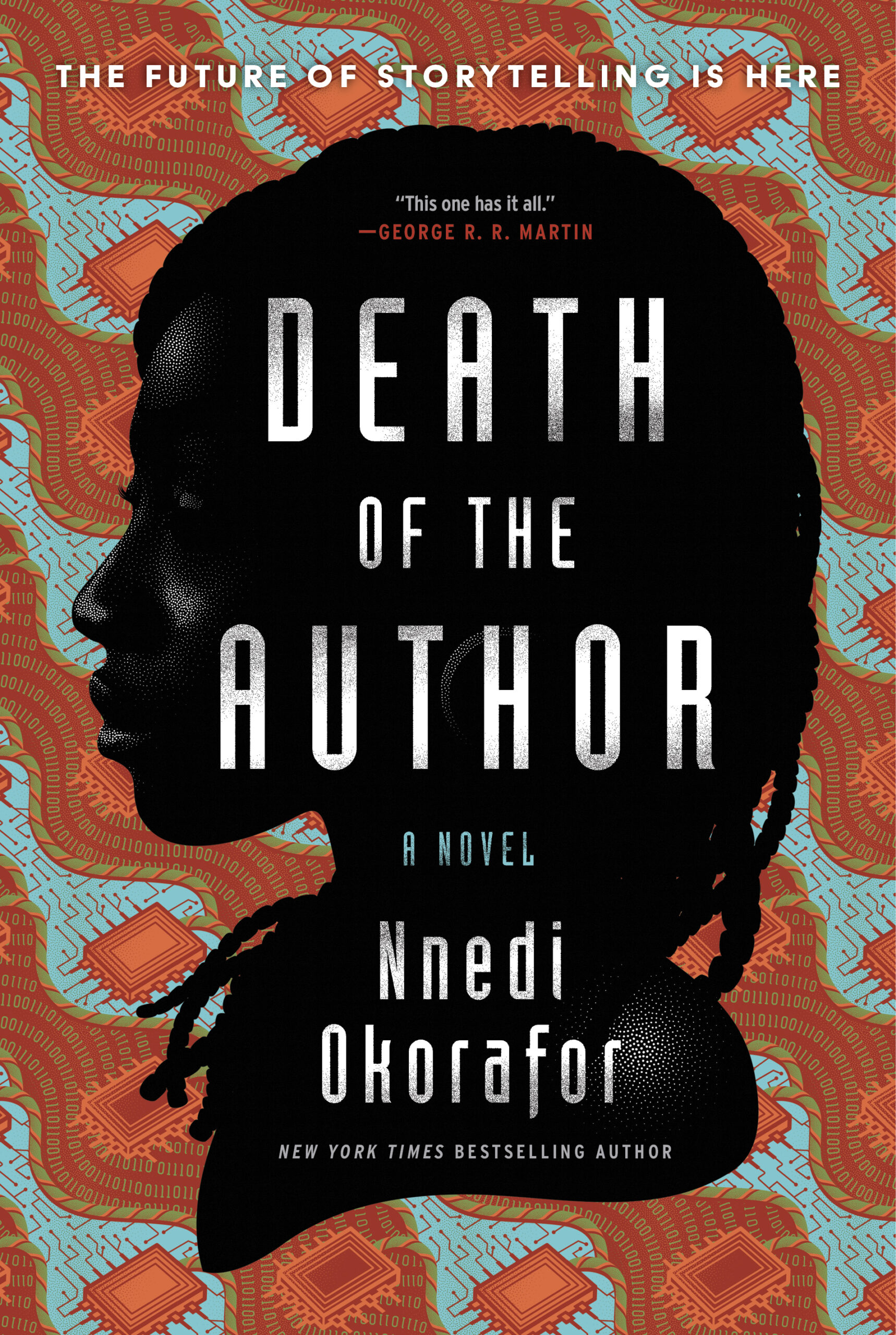
- The Good: A writer forges a new path for herself
- The Bad: Not so much scifi as a novel of literary family dynamics
- The Literary: Story within a story—alternating chapters with a robot in the post-apocalypse
Zelu is a struggling writer. Her latest novel isn’t picked up, she’s suddenly let go from her adjunct teaching position, and she dreads attending her sister’s wedding and having to face her entire family. An early childhood accident left her paralyzed from the waist down, and as the disabled member of the family, her parents still think she needs taking care of.
But the night of her sister’s wedding, she leaves early and in her hotel room starts writing a new kind of story. Not a literary novel like her previous ones, but a science fiction drama about androids after humanity’s demise. Her life changes dramatically, especially once the book is published and her reality takes a turn.
Nnedi Okorfor’s writing is highly recognizable. She’s quite prolific for such a young writer. She coined the term Africanfuturism and her work is instantly recognizable with its Nigerian protagonists. I’ve read several of her Hugo nominated novellas, including the Binti series, and I find them to be a mixed bag. I love the entirely new worldbuilding and scifi from a new perspective, but I find her protagonists largely inaccessible.
Death of the Author surprises me, as Zelu is immediately accessible, emotional, and sincere. This is a personal story of growth, a late coming-of-age tale while the protagonist author juggles wanting to live in the future but stay connected to her past and her family. Zelu isn’t necessarily a protagonist with whom you’ll fall in love—she’s stubborn and often self-indulgent, but she’s also ambitious and compelling.
This is lightly a science fiction story, with much focus on family dynamics and immigrant trauma. It’s also quite grounded in the present day, with social media and self-driving cars, with a slight nod to scifi with robot prosthetics and commercial space flight. Alternating chapters focus on Zelu’s book, whose protagonist, humanoid robot Ankara, meanders around a post-apocalyptic, post-human world — but honestly that storyline isn’t as compelling.
This story explores creators and their creations, and what happens when readers take a story for their own. Who owns these stories and who gets to tell them? Zelu must decide who she wants to be, juggling individualism and conformity, and forging a new path for herself despite familial and societal expectations.
All that said, I’m not a fan of the ending. It feels rushed, weak, and inconsistent. And while I think this is a really good book, and probably my favorite from the author, it doesn’t deserve to win the Hugo Award because it’s only nominally a scifi book. Recommended for fans of diverse literary fiction looking to read more scifi.