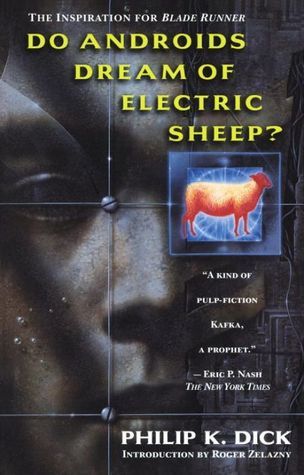
- The Good: Androids and thought-provoking philosophical science fiction
- The Bad: Meandering plot with some inconsistencies
- The Literary: The source material for many future science fiction media
Rick Deckard, former police officer turned bounty hunter, must find six rogue androids and “retire” them. But his once black-and-white thinking about the differences between humans and androids is soon called into question.
In the future dystopian world of 2021 (updated in recent editions from 1992), most animals species are extinct and the United Nations encourages people to leave Earth to live off-world — if they can afford it and meet quality regulations. Those who remain covet any living animal, all of which are endangered, and those who cannot afford them buy machine replicas for pets.
Replicas are so advanced that androids are indistinguishable from humans, so much so that a bone marrow test must be performed on the body of each retired android to confirm that it was not actually human. Immigrants to Mars receive androids, but governments on Earth have banned them, so unauthorized androids live among humans, their true identity hidden.
Originally published in 1968, Do Androids Dream of Electric Sheep? remains a masterpiece ahead of its time, a prescient rendering of a dark future. Many future novels and media take inspiration from Androids, but the original stands with a unique voice. This isn’t a perfect story, and you’ll likely see the gaps and inconsistencies, but the concept and style deserve all the accolades.
Many of you have likely watched the film adaptation Blade Runner, so if you’ve watched it before reading this book please disregard what you know and be ready for an even darker, more complex story. I love both the movie and the book for different reasons.
One of the major plot lines missing from the movie is that of Mercer, a half-Sisyphus half-Christ prophet who preaches communal suffering and shared empathy among humans. Followers, including Deckard’s wife, use empathy boxes to merge with Mercer and other humans to engage in a collective virtual consciousness. The empathy boxes create unity among humans, possibly allowing them to continue to live in such a dystopian world, but they also create a strong divide from androids.
Another fascinating science fiction device used in the novel is the Penfield Mood Organ, which allows for manual control of mood by means of setting a dial. Examples include “awareness of the manifold possibilities of the future,” “desire to watch television, no matter what’s on it,” “pleased acknowledgement of husband’s superior wisdom in all matters,” and “desire to dial.”
There are so many philosophical questions posed by this story. Are androids alive? Do they deserve rights or even the right to live? What is natural and what is artificial and how do you tell the difference? Is one category superior to the other? Can one category turn into the other? Both categories are subject to inevitable entropy, referred to in the book as kipple.
Though PKD’s writing is philosophical and often confusing due to his tendency to call into question reality itself, his novels are quite accessible. They’re not pretentious or ostentatious, but genuinely paranoid in their questioning of morals and motivation. He doesn’t fit neatly into genre, and most notable scifi writers either fall into the camp of high praise or “what’s all the fuss about?”, including Ursula K. LeGuin and Orson Scott Card, respectively.
You’ll have to read it to find out for yourself. For my part, I find Androids to be both a product of its time yet strangely prescient, and I have more questions than answers, but those questions will stay with me.
“I love you,’ Rachael said. ‘If I entered a room and found a sofa covered with your hide I’d score very high on the Voigt-Kampff test.”