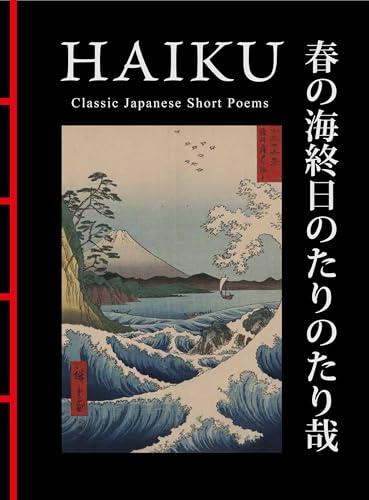
Haiku is an ancient form of Japanese poetry, and this volume features four famous poets, often known as “the Great Four”, Matsuo Bashō, Yosa Buson, Kobayashi Issa and Masaoka Shiki. Their lives and poetry span more than two hundred years.
This is an easy and short read, because if you know haiku, you know these small poems typically follow a strict succinct structure. Seventeen phonetic sounds, and if translated or written in English, then structured in a 5-7-5 format. They are typically written with a sharp image and a reference to a season.
The book itself is beautifully hardbound with traditional Chinese binding. Each poem is displayed in Japanese script, Japanese romaji, and an English translation. I can’t make much of either of the japanese renderings, except for the form, the shape. Japanese haiku (a three-syllable word in Japanese) is written on a single vertical line, but the translations use three lines to reflect the pacing.
I know Bashō, who is probably the most famous haiku poet, but it is a joy reading from the other three, finding their style and contribution to the art form. In chronological order,
- Bashō’s poems are magical, in that they hold a lightness, and they often delight, evoking a slight smile, while you think, isn’t that clever? But at the same time these poems convey a spiritual depth and a peace with the way of the world.
- Buson is evocatively tactile, often wet, sometimes cold, including ponds, streams, rivers, seas, shores, rain, dew, and wells. In his life, he was more successful as a painter, and I think of his poems as little paintings.
- Issa is a sweet whisper; his poems are innocent and playful, wry and irreverent, often noting the duality of a single moment. His poems often feature small animals and compassion for their own little lives.
- Shiki feels and is the most contemporary. His poems are passionate and charged. It’s clear that he favors portraying the world realistically, which often lends toward acknowledging the leftovers, the decaying, and the lonely.
Highly recommended for anyone interested in examples of the four great masters of haiku.