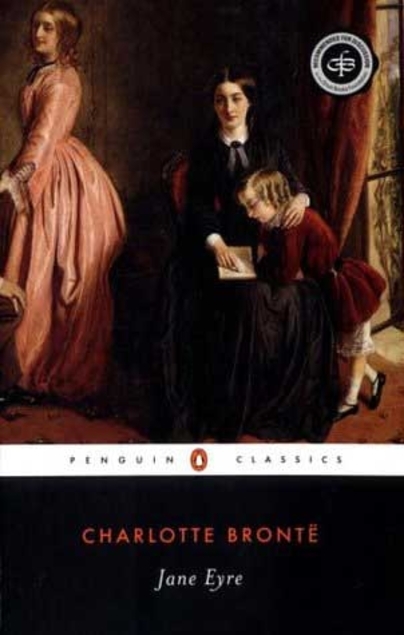
- The Good: Victorian feminism; a strong female protagonist
- The Bad: A marriage of pity; an overly convenient rise in social standing
- The Literary: A moral gothic literary treat
Jane Eyre is a classic gothic romance, and Charlotte Bronte’s first novel. Jane grows up in the home of her cruel aunt, before being sent off to school because of her natural independence and strength. She grows up and teaches at the same school before finding employment as a governess in the home of the brooding Mr. Rochester.
I’m interested in this novel because it’s both a passionate romance and a story about equality and early feminism. But on either front, I’m not sure it lives up in the way that I expected.
First, the romance. Jane’s feelings for Edward Rochester gradually develop during her employment at Thornfield Hall. It’s clear that Rochester is fascinated by Jane because she’s not like other girls, who fawn over him for his wealth and cannot hold a candle to his clever mind. In fact, Jane appears to have more wit and repartee than Rochester himself. Their romance is a meeting of the minds, and mostly they are great friends and enjoy spending long evenings together conversing by the fire. But I’m never really sure why Jane feels an attraction for Rochester. Sure, he isn’t interested in shallow conversation, enjoys hearing her opinions, and provides a sense of stability that she’s never had, but it doesn’t feel quite enough, and that’s where the romance fails for me.
Jane is also lauded as a feminist icon, primarily because she rejects Rochester’s proposal of marriage when she learns Thornfield Hall’s dark secret. I don’t want to give away any spoilers here, so let’s just say that Jane rejects not only Rochester but two marriage proposals. She prioritizes her integrity over security or comfort, which is a big deal for Victorian women. She also writes that “women feel just as men feel”, and her interior emotional and intellectual landscape is an example of that complexity.
To that end, I think the most powerful feminist message of this book is Jane’s strength of character. Jane is wholly her own person and she feels real. She’s not out having adventures or bucking the patriarchy. She’s trying to find a place in the world where she has a purpose and holds to her values, some of which are quite feminine.
Unfortunately, as a modern reader I can’t help but see a lot of unfeminist things in this novel. The terrible secret of Thornfield Hall, which I really don’t want to spoil, could be read as a harsh punishment of female passion and savagery of the darker races. Jane herself has no desire for broader political, legal, or educational equality for women, and, in fact, is happy when her French ward is educated out of her French ways to be of a proper British temperament.
Jane’s financial situation is also too convenient. She is a hard and diligent worker, but her ultimate ability to return to Rochester on equal financial terms is not of her own making but because of an unexpected inheritance. This windfall allows Jane to ascend the strict Victorian class system overnight, and it doesn’t feel earned by the narrative.
I also have mixed feelings about the necessity of a happy ending by way of the moral reformation. Rochester is physically humbled for his sins, and he loses much of his fortune. Both Jane and Rochester admit God’s punishment for his arrogance. The traditional power dynamic shifts, and Jane chooses marriage entirely on her own terms, financially and emotionally and physically. But this ending simultaneously makes the romance feel more calculated and less passionate and also reinforces the traditional class lines, as Jane achieves her goals by ascending the social ladder.
There are two camps of Bronte fans, those for Jane Eyre and those for Wuthering Heights. I appreciate Jane Eyre for many reasons, for Jane’s character and the beautiful prose, but I love Wuthering Heights. Let me take a few paragraphs to explain.
Jane Eyre’s romance is a transaction between power and morality. For Jane, giving in to passion without a social and religious framework would mean a loss of integrity and self-worth. Love has to be earned through moral endurance, and when Jane finally has the upper hand in the relationship, the romance shifts from something dynamic and passionate into a safe domestic partnership, with Jane as the caretaker.
In Wuthering Heights, Catherine and Heathcliff’s relationship is based on pure obsession, and their love is entirely unbothered by human conventions like law, religion, or even death. Their love is a passionate forbidden affair. They are willing to destroy themselves, and everyone around them. Their passion is a force of nature, like a storm, and they are swept up in it to their ultimate demise.
But let’s get back to Jane Eyre. This book is great storytelling. Jane is fiercely honest about her flaws, her jealousy, her anger, and her desires, so she feels like a living, breathing person rather than a stiff Victorian trope. Whereas I love the gothic horror elements of the story (ie the terrible secret of Thornfield Hall), this is more about a strong woman whose spirit isn’t crushed in a world that doesn’t care and in which people who are supposed to love her only use her as tools for their own purposes. The prose is incredibly rich and cinematic, from the shadow-drenched corridors of Thornfield Hall to Jane wading knee-deep into the dark heath on the vast, lonely moors.
Highly recommended for fans of gothic, feminist, classic literature!