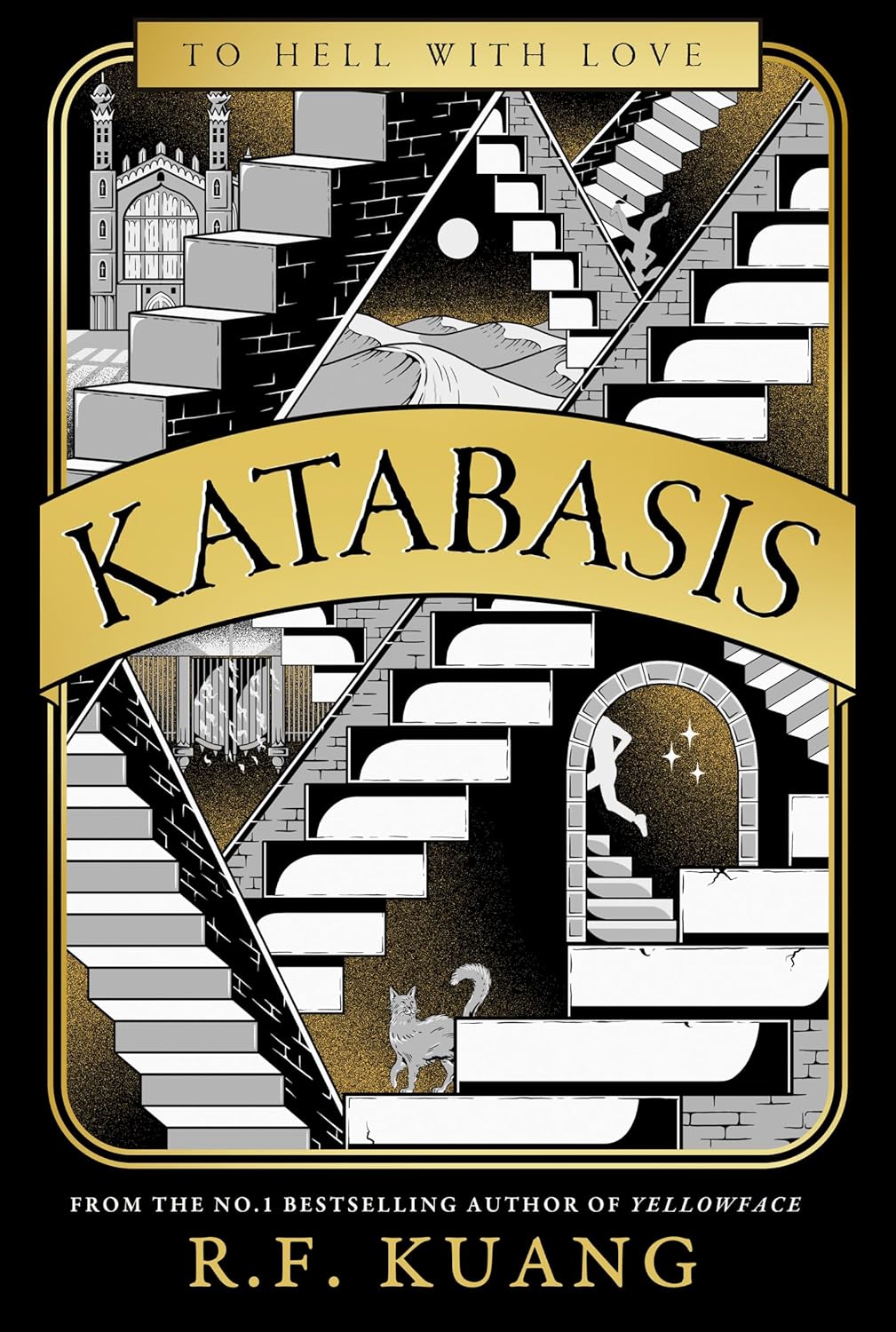
- The Good: A journey into Hell in which Hell is graduate school
- The Bad: Underdeveloped fantasy and magical elements; unsubtle critique on academia; too long
- The Literary: Lots of literary and philosophical references
Alice Law is a brilliant graduate student at Cambridge University. She’s sacrificed her health, pride, social life, and her sanity to work under the greatest magician in the world, Professor Jacob Grimes. But when Grimes unexpectedly dies in a magical accident, Alice decides the only way to graduate is to go to Hell after him.
I had exceedingly high hopes for Katabasis, in which two graduate students journey into the underworld to save their professor. I loved Babel, Kuang’s other academic fantasy novel, which is about student uprisings and colonialism, and centered around languages and translation as a magical system. Babel won both the Nebula and Locus science fiction and fantasy awards in 2023.
But Katabasis is only okay. You would think I’m the prime audience for this novel. I too fought my way through the Hell that is graduate school, and I know firsthand the pretentious world of academia. So I understand Alice’s longing to go to Hell to rescue her professor. Who else is going to write her recommendation letters? The post graduate studies and low level professor jobs aren’t any easier to acquire, and even a misstep could lose the hope of a future tenured position.
I enjoy that this is an academic novel through and through, beginning at Cambridge, where Alice researches every myth about the underworld she can find, because in this world, they’re all likely true, at least as perceived by the author. Magicians use ancient bone dust as living-dead energy (ie chalk) to draw pentagrams. Logic, puzzles, and mathematical proofs allow the rules of reality to bend when applied by a magician. There’s even a scene where Alice snorts chalk and things get a little psychedelic.
Just before Alice sets off, her fellow graduate student and rival, Peter Murdoch, forces his way onto her expedition. Over the course of the novel, flashbacks reveal that Alice and Peter were once good friends, but Peter’s cavalier attitude, and Grimes’ attention and funding, cause a rift between them. But soon enough, their shared trauma under Grimes come to light, and they both realize how much the system and their advisor have hurt them.
Kuang doesn’t shy away from depicting rampant misogyny, including rifts between women in the department, eating disorders, professors taking all credit for their students’ work, sexual harassment, a system that doesn’t allow for health breaks, and the many abuses of power that are overlooked everyday. This is a critique on the world of academia that is formally clever, if lacking subtlety.
Unfortunately, the plot is meandering, full of holes, and a slog. Hell is a lot like university, complete with libraries and dissertations, so it doesn’t feel as scary as it should. There’s little in the way of religion, theology, and only some passing references to mythology, so the potential complexity of Hell feels smaller than it should. Magic is all chalk and pentagrams, and since those objects are so easy to comprehend, the magic doesn’t feel magical. The paradoxes at least move the plot along, like when Peter uses the Hangman’s paradox to get Alice out of a tight spot. But overall this is a tedious read, since logical puzzles aren’t exactly brimming with narrative tension. All that said, I mostly see a missed opportunity for imagination.
Lots of people love this, so give it a try if you love dark academia and logical puzzles.