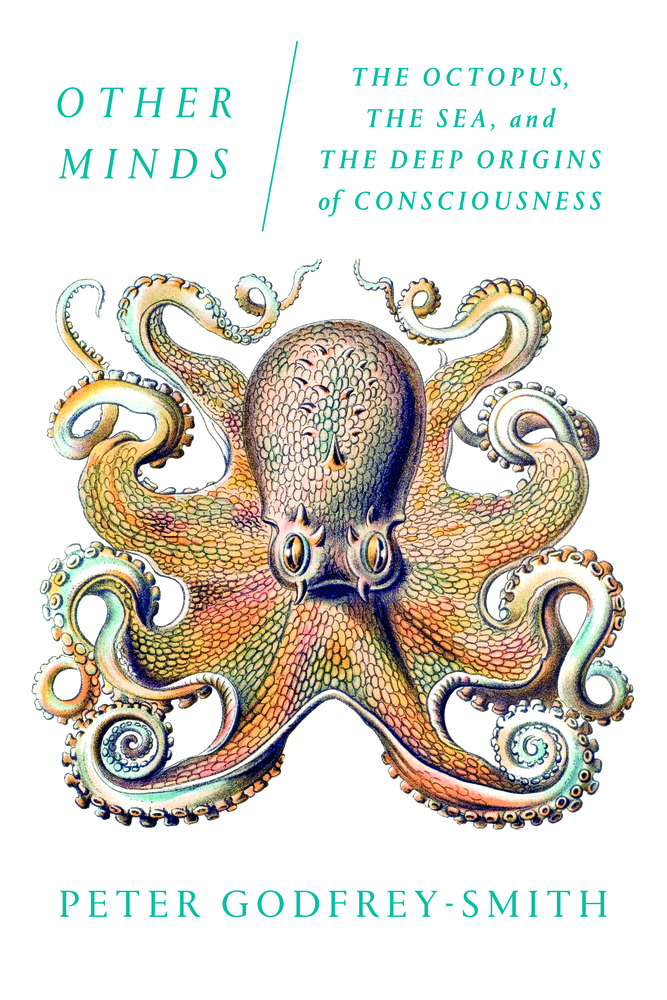
What is it like to be an octopus? In this nonfiction dive into their evolution and biology, philosopher Peter Godfrey-Smith crafts a story of how unlikely it is that intelligent cephalopods came to think for themselves, and how different that “thinking” is from our own.
Before picking up this book, I knew octopuses were smart, but I didn’t appreciate how alien and distant they are from humans and all other vertibrates, and therefore how incredible it is that through evolution, consciousness likely emerged twice. You may not agree that octopuses are conscious, but there’s a larger discussion on the definition of consciousness that we don’t have time to get into here.
So let’s start with octopuses in captivity. They easily identify individual human keepers, trusting some while aggressively shooting water at others. They raid neighboring tanks for food, turn off lightbulbs, plug drains, choose destruction instead of food rewards, and make daring escapes. They have wildly different personalities between them and do not interact much with one another, in captivity or in the wild.
It’s not just octopuses either, there are also the squid and cuttlefish families, which each have their own unique behaviors and biology. For example, cuttlefish in particular change color to hide from predators and hunt, but also to communicate. They use flashing patterns and waves of color to signal rivals or show aggression or accept a mate. Tiny pigment-filled sacs in the skin expand and contract instantly using attached muscle fibers, and direct neural impulses from the brain control each individual color cell to create complex, moving patterns in milliseconds. Even more fascinating, the cuttlefish eye lacks necessary components to see color.
The direct neural impulses to each individual color cell is something very alien to us mammals. Even more, these cephalopods do not have a single localized brain. Instead, neurons are distributed throughout their bodies. For the octopus especially, each of their eight tentacles essentially has its own brain that acts independently of the main body.
The first part of the book focuses on the evolution, where individual cells clumped together to form primitive organisms before evolving nervous systems. The first organism we might recognize would have been an early ancestor of the jellyfish. Cephalopods arose from mollusks who abandoned their protective shells and rose above the ocean floor, slowly acquiring intelligence over generations.
Godfrey-Smith convinces me how incredibly different these creatures are from us, and how far away they are on the evolutionary tree. Every other organism we think of as intelligent—chimps, elephants, crows, pigs, dolphins—are practically brothers and sisters compared to the octopus. Our earliest common ancestor was likely a blind worm who crawled along the ocean floor and displayed a bilateral symmetry. We’re more closely related to starfish than cephalopods. For those of you not as interested in the evolutionary tree, I will admit that this section of the book can be slow.
However, the author’s own personal experience scuba diving bring it closer to home. A unique location off the coast of Australia facilitates a small city of octopuses, which he visits frequently, getting to know a few of them. Brave and curious individuals explore his suit and equipment, trusting him implicitly.
There are a lot more great facts in this book, but as Godfrey-Smith is a philosopher, it’s important ask the open questions too. What does it mean that evolution built minds not once but at least twice? What is it like to have eight tentacles that are so packed with neurons that they virtually “think for themselves”? What does their intelligence teach us about our own?