- The Good: Hard scifi about artificial consciousness
- The Bad: Theoretically dense; minimal character development
- The Literary: John W. Campbell Award-winner
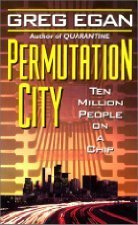
It’s 2050 and Paul Durham is creating yet another Copy of himself. He’s doing a set of experiments by cloning his consciousness in a virtual reality, but every Copy chooses to commit suicide and delete themselves after about fifteen minutes, and he’s determined to find out why.
In this near future reality (which feels surprisingly still relevant as a future though the novel is over thirty years old), Earth is a ravaged by climate change and humans have access to vast amount of computing power and memory on a global market. The wealthy few pay to have their brains scanned and emulated in this virtual reality, and these scans are detailed enough to allow for a subjective conscious experience.
Several other characters are worth mentioning, including Maria Deluca, who is addicted to an artificial life simulator, where a small group of enthusiasts are obsessed with getting a digital lifeform to evolve. Simply put, she spends all her money on digital chemistry experiments. Her mother is dying, and Maria is desperate to convince her that she should scan her brain, But not only does her mother refuse, but it would cost more money than either of them have.
Peer and Kate are both Copies living their lives in a virtual reality. They love each other, but also want different things out of their virtual lives. Peer, in particular, loves editing his perceptions and his own code. They’re part of a subculture called the Solipsist Nation, representing the poorer, slow-running Copies who can only afford computing time when it is cheapest, putting them out of sync with real time. Because they can’t interact with wealthier real-world societies, they deliberately reject external reality and construct their own subjective universes.
Thomas Riemann is an aging wealthy banker who covets immortality. In his youth, he committed a murder that’s never come to light, and as he creates his own Copy, he wonders if he should remove this part of his past, relieving him of his lifelong guilt. But, once removed, Thomas wonders if he would be the same person or a different person.
I’ve spent several paragraphs on the characters, but I will admit that Egan is not a character writer. His characters don’t so much develop; instead, they are vehicles for the ideas. I love the breadth of ideas, wild philosophies, and abstract arguments throughout, so let me share some of my favorites.
It’s easy to say this is a book about consciousness, but I’d argue that Egan doesn’t so much argue that Copies are conscious, as he blows right past that idea and just assumes they are. Instead, Egan asks what parts of ourselves we could delete or edit and still be the same person.
Only the wealthy can afford to be Copies, but even Copies live in a world with economic disparity. The wealthy copies sometimes slum it with poorer copies by slowing themselves down in Slow Clubs. But even the uber-wealthy Copies, who still maintain trust funds in the real world, don’t have legal rights.
Durham eventually postulates Dust Theory and that any universe that is theoretically possible mathematically actually does exist, implying that once a Copy is deleted, it’s consciousness and experience continue to exist. Durham uses this theory to convince several wealthy patrons that he can provide them with immortality.
There’s also a very cynical reading of religion and God here. The Church of the God Who Makes No Difference satirizes organized religion, showcasing a God who exists but does nothing. The climax of the novel manages to disprove a creator God, at least in some small way, though we readers know from the story that there was in-fact a creator. I know it’s confusing, but trust me, this book finds God to be unnecessary.
Sure, sometimes the plot goes a little off the rails. But I’m willing to forgive that. I’m not quite willing to forgive that both of the women protagonists are the doubters, and it’s the men who have all the ingenious ideas. At least Maria is a subject matter expert.
Permutation City is a philosophical science fiction novel that explores so many ideas, and it also won the John W. Campbell Award for the best science-fiction novel of the year in 1995. I can see why. The complexity of ideas is a challenge, but don’t let that deter you. This is an exploration of ideas, not a proof.
I’ve never read anything like it, and it will be with me for some time. Highly recommended for fans of hard scifi!