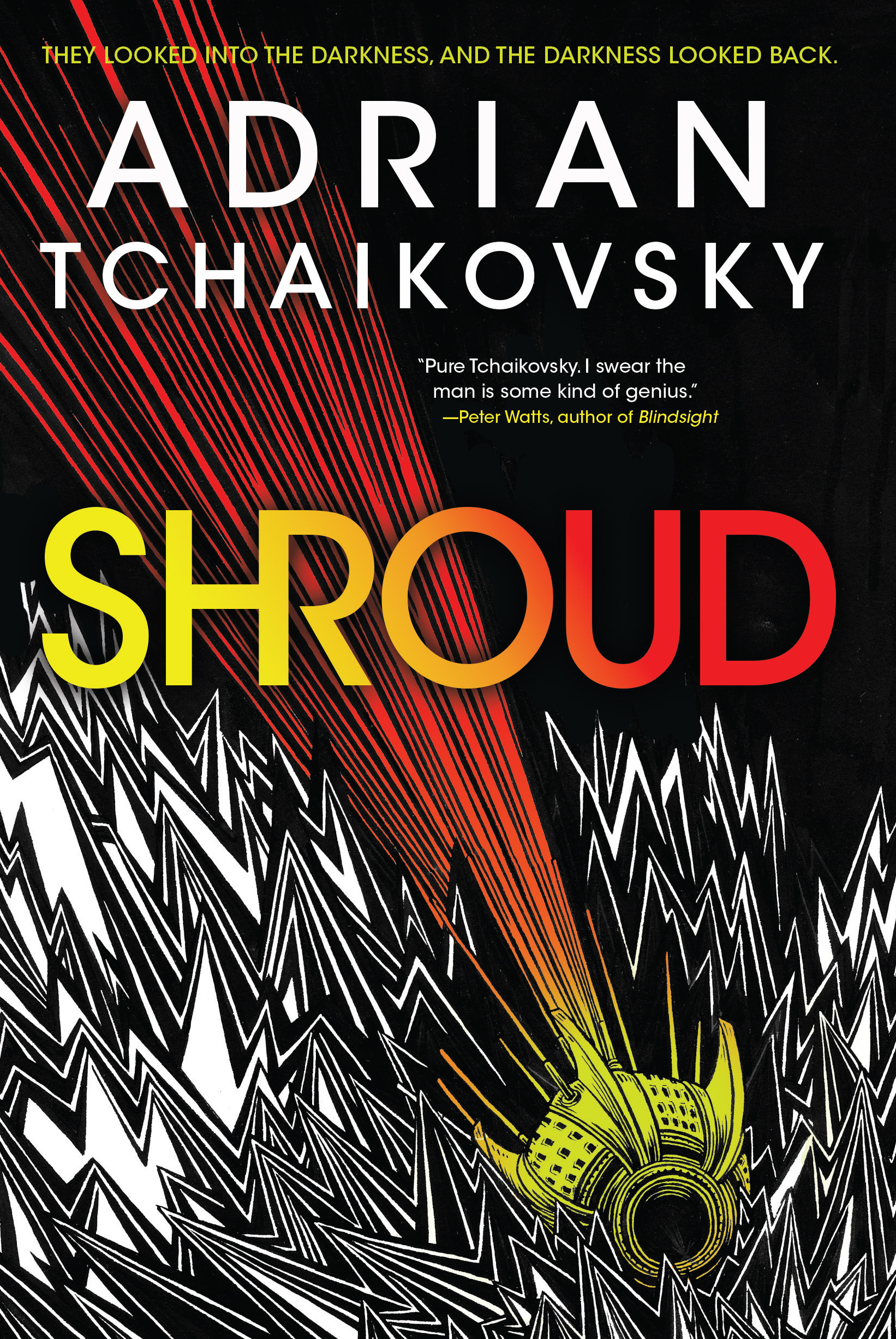
- The Good: A high-stakes survival story, alien first contact, and corporate satire
- The Bad: Surprising slow pace for most of the book; limited character development
- The Literary: Philosophical scifi that implies humans aren’t ready for first contact
Juna Ceelander is a crew member of the Garveneer, sent to investigate and mine a moon named Shroud. Their Concern (the modern word for their company) relentlessly work the crews with the goal of spending the least amount of money to extract the most resources. The high-gravity, pitch-black, zero-oxygen planet shouldn’t be hospitable to life, but drones used to build a space elevator eventually prove otherwise.
A fair amount of time is spent before the inciting incident, which I’ll reveal here since it’s also in the book blurb. Eventually Juna and a couple of crew mates crash land on Shroud, and then the real adventure begins. But before that, Juna and her colleagues work around the clock, pop uppers for double and triple shifts, and downers to sleep, just to get up and do it all over again. It feels eerily prescient that the Concern is not at all concerned with their employees, safety, or really any morals. So the crash landing is really no surprise, as the crew are at their limits, and every team has cut redundancies and backup systems to save time and money.
Juna and her crew mate Mai are the center of the rest of the story. They’re an odd couple, which reads well during their plight down on Shroud. It’s not long before the Shrouded surround their escape pods, overwhelming their systems with electromagnetic radiation. What follows is a series of misunderstandings as Juna, Mai, and the Shrouded attempt to understand and communicate with one another, mostly unsuccessfully. If you’ve read Tchaikovsky before, you know he does this kind of thing extremely well, and you won’t be surprised that there are some chapters from a Shrouded’s point of view. There are many interesting scifi concepts specific to the Shrouded, but I’ll let you discover those on your own.
Shroud is a scifi first contact novel in which humans aren’t interested in first contact at all. Instead, the humans in charge would rather deny the potential of non-human intelligence, as it interferes with their ability to procure a planet’s resources, in this case, strip-mining. But Shroud is also about communication, between two humans facing imminent death, and between a scientist and an engineer trying to understand an alien species they believe to be intelligent, but with which they have no common ground.
This isn’t a humorous novel, but it reminds me of the scifi comedy The Hitchhiker’s Guide to the Galaxy, in which Ford Prefect mistakes cars for intelligent sentient creatures, with humans as their caretakers. Similarly, the Shrouded believe the escape pod is the intelligent creature, and don’t even consider that there could be intelligent creatures inside piloting it. There are also nods to Starship Troopers, as the leaders in the Concern work so diligently, so patriotically, for the goals of the Concern, refusing to believe that the Shrouded are worth their time.
If you are unfamiliar with Tchaikovsky, all his works explore similar themes — so if you like this, definitely try out his other works, particularly Elder Race (which explores communication between scifi and fantasy characters in a single story), and Alien Clay (in which a biologist is forced into a labor camp by an oppressive regime on an exoplanet assumed devoid of life). Recommended for fans of scifi and political/corporate satire.