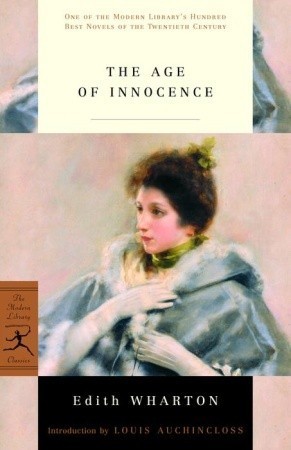
- The Good: An unconventional love triangle in 1870s high society New York
- The Bad: The dangling possibility of a relationship is drawn out for too long
- The Literary: Wharton was the first woman to win the Pulitzer Prize with this gem
During the Golden Age of 1870’s old New York City, young upper-class lawyer Newland Archer is smitten with his fiancee May Welland, a charming, sheltered, and beautiful young girl. The arrival of May’s cousin, Countess Ellen Olenska who is divorcing her unfaithful Polish Count husband, brings potential scandal on the family. But Newland becomes intrigued with the exotic and fascinating Ellen, who makes May seem ignorant and shallow by comparison.
Winner of the 1921 Pulitzer Prize, The Age of Innocence is an American Austen-esque novel of a romantic entanglement set against a critique of wealthy societal structures and laced with wry subtle humor. The setting is full of pretty dresses and parties and inane conversation that is delightfully ridiculous. Newland is happy with all of it until he falls desperately in love with his wife’s cousin.
But this isn’t your classic love-triangle. Newland is torn between duty and stability and expectation with his fiancee May, and a passion for the ostracized Ellen, who represents a new way of thinking that isn’t limited by convention. Newland slowly becomes aware of how small a woman’s place is in society and in marriage, and he doesn’t understand how everyone he’s ever known, including May, could live in such circumstances. He realizes his own views towards May were those of ownership more than love.
I really enjoy that this story is about new ideas in an old world. A new American way of life set against the old world of Europe. The Victorian era moving into a modern twentieth century. Since the book was written and released decades after the era of its setting, the pre-world-war age seems particularly innocent.
In addition, in our modern age we alternate between coveting opulent lifestyles and following luxury trends versus movements to “eat the rich”. The same seems to have been true in Wharton’s era, as the story allows the reader to enter a world where the protagonists are not only financially comfortable, but who live glamorous lives, visit the opera, and attend parties to judge one another. For those of us who have to work for a living, it’s nice to revel in the opulence while feeling superior for not being so shallow. For a visual representation of this ritz and glamor, watch Martin Scorsese’s 1993 film adaptation.
The will-they-won’t-they swings between Newland and Ellen are a bit tedious, but suffice it to say that while Newland thinks himself a cunning man to find a way for him and Ellen to be together, things do not turn out as expected. I don’t want to spoil anything here, but this love story is bittersweet. The villain, if there is one, is not who you think it is, and innocence, as such, is only a facade.
Highly recommended for fans of period romantic dramas!