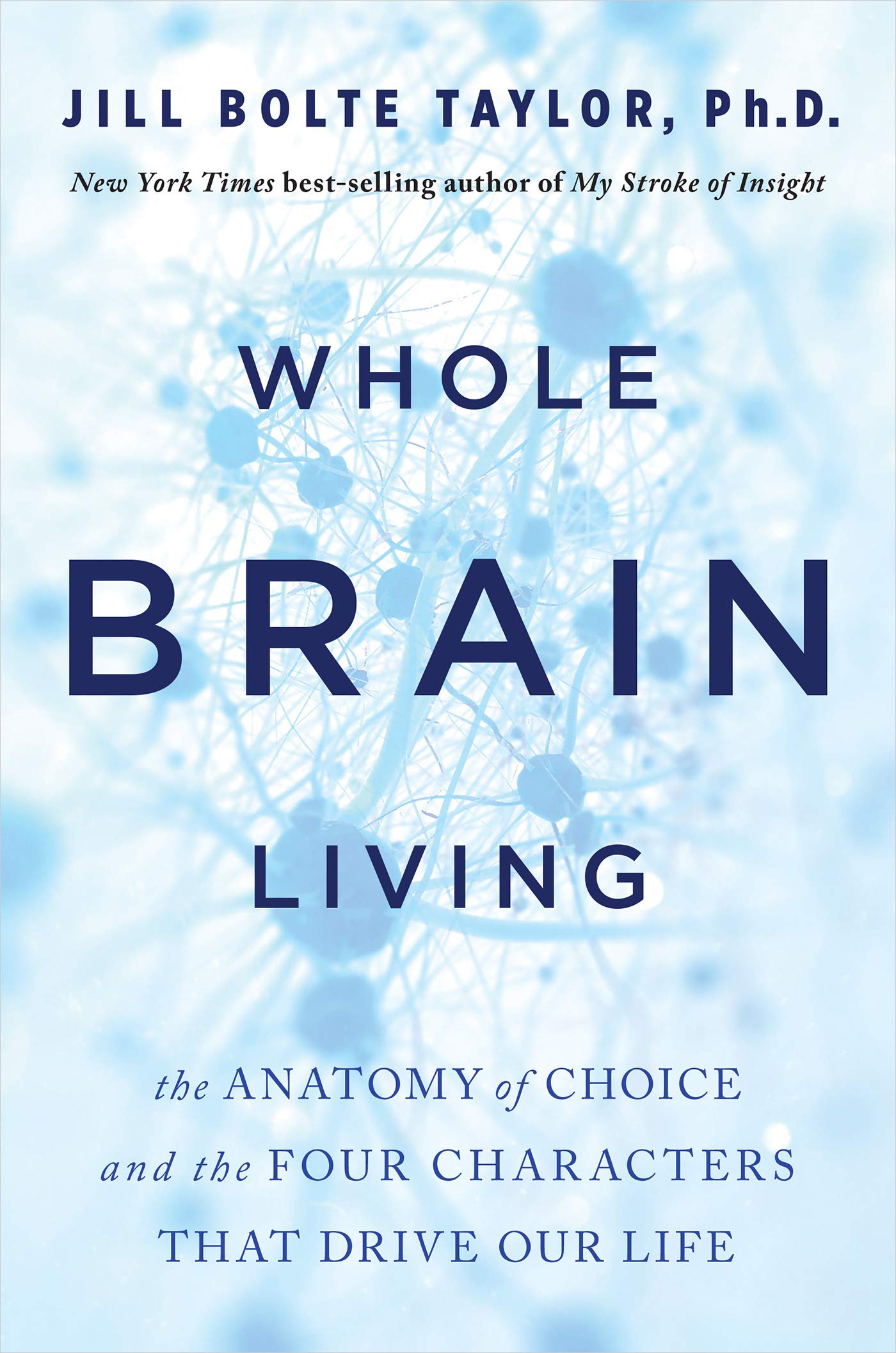
Neuroanatomist Jill Bolte Taylor suffered a left-brain stroke at 37 years old. Her recovery spanned eight years and included learning how to speak again. Since then, she’s been speaking and writing about her experience. Here, she blends neuroanatomy with psychology to show how we can stop emotional reactivity in its tracks and find our way to peace.
You may guess that this book focuses on left and right brain differences, and Taylor extends that to defining four distinct regions of the brain. The left and right brains each have their own emotional limbic tissue divided between them, so we have Left Thinking, Left Emotion, Right Emotion, and Right Thinking.
These four characters each display their own particular set of skills and thought patterns, and are psychologically similar to the theory of internal family systems, in which the mind is a collection of distinct sub-personalities. Taylor recommends a Brain Huddle practice in which each of the characters are brought into the conversation and heard, before decisions are made.
Taylor’s story is pretty incredible, so I recommend her Ted Talk as an introduction. However, the book falls short for me on several accounts. First, from a neuroanatomist I expect a lot more science and references to current research. But Taylor admits that she purposefully turns away from left brain thinking as much as possible because she finds a lot more joy in right brain thinking, specifically creativity, art, imagination, non-literal thinking, and exploring mysticsm.
That’s ok, I can let go of the science. I’m also here to explore how people create space in their adult lives for creativity, play, and flow states. In addition, this book specifically advertises analogies with the Hero’s Journey and Jungian analysis. Unfortunately, these are only briefly touched upon, and although Taylor wants everyone to be more right-brained, she doesn’t have any specific tips or strategies.
Most of the book is describing these four characters and what their traits are, before following up with how they interact with technology and addiction, and I find most of this exploration to be superficial and anecdotal.